Category: General Posts

  • Bump Up the Jam: 8 Bump Combat-Based Games to Play in 2025

    Bump Up the Jam: 8 Bump Combat-Based Games to Play in 2025

    While the Ys series has evolved quite dramatically since its inception in 1987, fans of the series may find themselves pining for older, more familiar times.

    And so if you have caught yourself wishing for more of the simple, addictive bump-based combat of Ys I, II, and IV: Mask of the Sun, here are eight bump-adjacent games from the classic and modern eras to whet your appetite.

    Classic Games
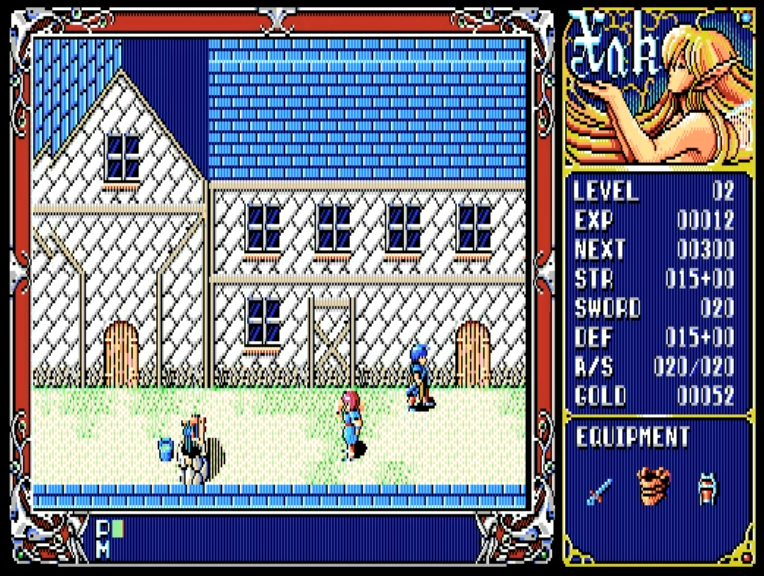
    A screen shot of “Xak” looking very Ys-like on the MSX2.
    • Dragon Slayer (1984)
      • Predating Ys by three years, Nihon Falcom’s Yoshio Kiya arguably began the Action RPG genre as we know it by releasing this classic for the PC-8801. As RetroXP’s Marc Normandin says: “Dragon Slayer, as said, utilized bump combat, but you didn’t need to hold down a button to attack. Instead, the emphasis here was on learning when to engage in battle, and when to avoid it.”
    • Hydlide (1984)
      • Of course, Dragon Slayer was not the only game released in Japan in 1984 with claims over the beginnings of the ARPG genre. Seminal favorite Hydlide allowed the player to switch between attack and defend mode. It sold more than 2 million copies in Japan but failed to make a splash outside of it.
    • Tower of Druaga (1984)
      • Yes, a third 1984 ARPG, this time a Namco arcade entry. It is credited with being a massive inspiration for games like Ys and The Legend of Zelda, but also struggled to find a North American audience.
    • Xak (1989)
      • Two years after Ys took Japan by storm, developer Microcabin released Xak on the MSX2 (and several other engines). All you have to do is check the screenshot above to guess at how much it might have been directly inspired by the Ys games.

    Modern Games
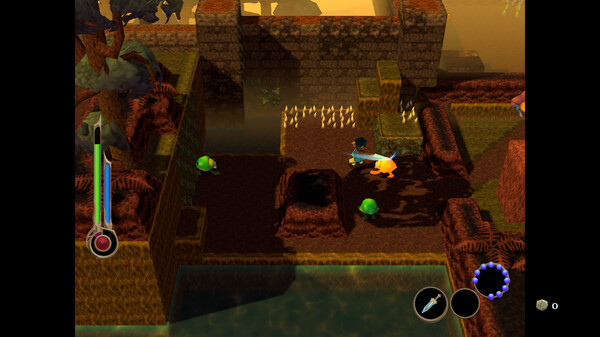
    A screenshot from the Steam Page of the upcoming “Bumpslash” game Angeline Era
    • Angeline Era (Upcoming 2025)
      • This as-yet unreleased game has a Steam demo available, and bills itself as a “Bumpslash Action Adventure Game” – all of which reads to me as bump-combat for the modern era. While it’s not a one-to-one equivalent to Ys’s original bump combat, it may well serve as a close enough facsimile to satisfy your whims.
    • Fairune Series (2018-)
      • The four games of the Fairune series (1, 2, Origin, and Blast) can be had for less than $10 USD and offer simple combat styled heavily after the bump system. It has pleasing 8-bit-inspired graphics and catchy chiptune music to boot.
    • Half-Minute Hero (2012)
      • While this game, which I first played on the PlayStation Vita, is much more than a simple bump combat simulator, its fighting is indeed quite similar to that of Ys I combined with the profile view of Ys III: Wanderers from Ys. It’s great for short gameplay sessions and has a sequel available on Steam as well.
    • Witch & Hero (2016)
      • Like the Fairune series, Witch & Hero is a heavily 8-bit-inspired game featuring bump combat. It’s a short game that can be yours for $5 or less (depending on what sales Steam has going on), and well worth a try if you’ve got a bump-based itch to scratch.

    I hope that you enjoy playing through some of these excellent bump-based games!

    And if you have any other suggestions, I’d love to hear them in the comments.
  • It Ys What it Ys: A Quiz Show of Negative Steam Reviews

    It Ys What it Ys: A Quiz Show of Negative Steam Reviews

    Welcome to It Ys What it Ys, YsLink’s new game show where you have to guess the Ys game based on a random, context-free negative review from Steam.

    I’ll give you five negative reviews of increasing difficulty.

    Read each one over, make your guess, then highlight the answer to see if you’re right. To help you out a bit, no games will repeat.

    And once you’re done, be sure to let us know on Bluesky what your score was!

    Ready? Let’s begin!


    Round 1: Easy

    Let’s start it off with a simple one, and perhaps even one that many people who read this will agree with!

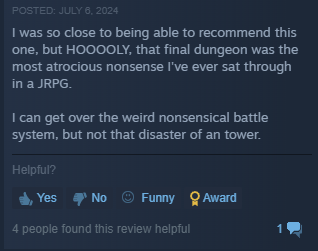
    I was so close to being able to recommend this one, but HOOOOLY, that final dungeon was the most actrocious nonsense I’ve ever sat through in a JRPG.

    I can get over the weird nonsensical bat tle system, but not that disaster of an [sic] tower

    Click for Answer

    Ys I & II Chronicles+

    Round 2: Normal

    Now let’s get dramatic. Which game is this from?

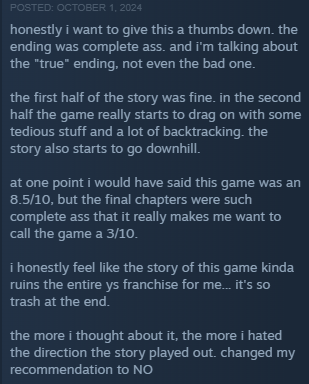
    honestly i want to give this a thumbs down. the ending was complete ass. and i’m talking about the “true” ending, not even the bad one.
    the first half of the story was fine. in the second half the game really starts to drag on with some tedious stuff and a lot of backtracking. the story also starts to go downhill.
    at one point i would have said this game was an 8.5/10, but the final chapters were such complete ass that it really makes me want to call the game a 3/10
    i honestly feel like the story of this game kinda ruins the entire ys franchise for me… it’s so trash at the end.
    the more i thought about it, the more i hated the direction the story played out. changed my recommendation to NO

    Click for Answer

    Ys VIII: Lacrimosa of Dana

    Round 3: Hard

    How are you doing? I think it’s time to get a bit more vague and a lot more hostile.

    (This was my personal favorite of the bunch.)

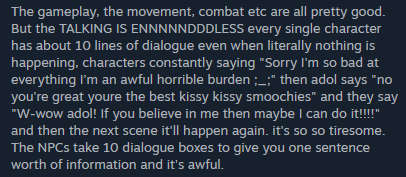
    The gameplay, the movement, combat etc are all pretty good. But the TALKING IS ENNNNNDDDLESS every single character has about 10 lines of dialogue even when literally nothing is happning. characters constantly saying “Sorry I’m so bad at everything I’m an awful horrible burden ;_;” then adol says “no you’re great youre the best kissy kissy smoochies” and they say “W-wow adol! If you believe in me then maybe I can do it!!!!” and then the next scene it’ll happen again. it’s so so tiresome. The NPCs take 10 dialogue boxes to give you one sentence worth of information and it’s awful.

    Click for Answer

    Ys IX: Monstrum Nox

    Round 4: Nightmare

    Now the going really gets tough. Think you can identify which game this is?

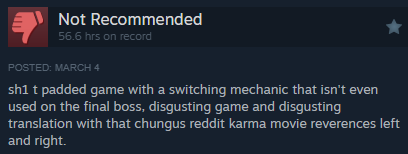
    sh1 t [sic] padded game with a switching mechanic that isn’t even used on the final boss. disgusting game and disgusting translation with that chungus reddit karma movie reverences left and right.

    Click for Answer

    Ys Seven

    Round 5: Inferno

    Last but certainly not least. Can you guess the game?

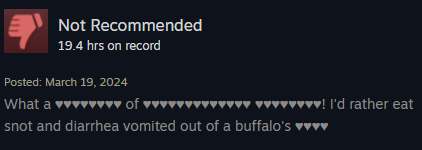
    What a ********* of ************ *********! I’d rather eat snot and diarrhea vomited out of a buffalo’s ****

    Click for Answer

    Ys: The Oath in Felghana


    So, how’d you do?

    Let us know on Bluesky or in the comment section below what your score was!

    And just maybe we’ll see you next time on It Ys What it Ys!

  • Ys is a Metroidvania

    Ys is a Metroidvania

    As Ys has slowly devoured my life and my Steam Deck’s battery, I’ve begun to ask myself why. Why did this franchise get such a hook in me in a way that excellent ARPGs like Secret of Mana, NieR: Automata, and many others didn’t?

    I think it’s because Ys is (not so) secretly a Metroidvania.

    Along with my abiding love of JRPGs, Metroidvanias have a firmly rooted place in my heart. I got the true ending on Hollow Knight, 100%ed both games in the Ori series, and even did speedruns of Gato Roboto for a time.

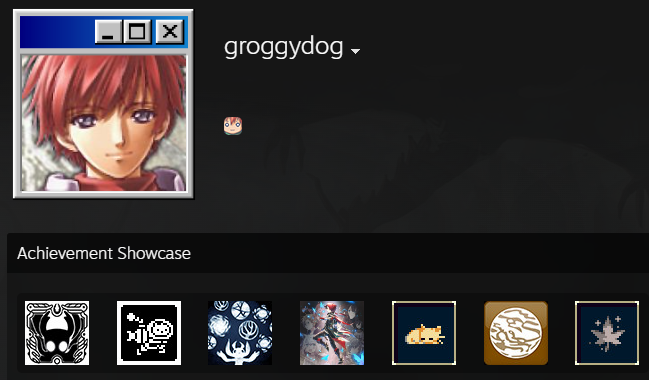
    A screenshot of my Steam profile, showing True Ending, 100% completion, and even deathless achievements for games like Hollow Knight, Gato Roboto, and Momodora 4. Plus a cheeky Ys IX platinum for good measure.
    A screenshot of my Steam profile, showing True Ending, 100% completion, and even deathless achievements for games like Hollow Knight, Gato Roboto, and Momodora 4. Plus a cheeky Ys IX platinum for good measure.

    Now obviously Ys is marketed as a series of Action RPGs, and I believe that that is a broadly accurate descriptor. But the same aspects that make Ys stand out within the ARPG genre also make it structurally identical to the best that the Metroidvania genre has to offer.

    To wit, let’s look at some common characteristics of Metroidvania games and how they’re seen in the Ys franchise.

    1. Ability-Gated Progress

    Seen perhaps most obviously in Ys IX: Monstrum Nox (the most Metroidvania of all the Ys games, in my opinion), this basically just means that parts of the map are visible to you but not accessible until you’ve unlocked certain abilities.

    A screenshot of exploring Ys IX

    For Ys IX, the way you interact with the early game’s map looks completely different to the end game. You’re grounded and slow to start. But by the later chapters you’re flying over rooftops, dashing up walls, and slipping under low gates. 

    Even in games like Ys VIII, however, you find map progress occasionally gated behind the number of people you’ve added to your campsite. Slightly different, yes, but thematically the same.

    I don’t see how this is functionally any different than unlocking a new missile in Metroid, and I think the fact that many Ys games let you unlock double jump speaks for itself.

    1. Emphasis on Exploration

    One of the most rewarding parts of the Ori series is its unbelievably beautiful scenery. Exploration in that game is its own reward.

    Luxuriously beautiful screenshot of Dana and the Great Tree in Ys VIII
    Taken from Steam user “sht”: https://steamcommunity.com/sharedfiles/filedetails/?id=3450009282

    Similarly, I argue that Ys VIII: Lacrimosa of Dana places a great emphasis on exploring the Isle of Seiren to unlock landmarks, discover hidden treasure chests, and ultimately aim for a 100% completion rate.

    However, I would say this is one potential sore point: in the Ys games, exploration is generally not required to progress. Especially in the more recent games, the actual game progress is linear. The earlier bump combat games, though, and to some extent the Napishtim engine games, do implicitly encourage exploration as a core mechanic.

    1. Interconnected Map Sections

    Starting with the very first game, a tight, interconnected map has been a staple of the Ys franchise – just like with Metroidvanias.

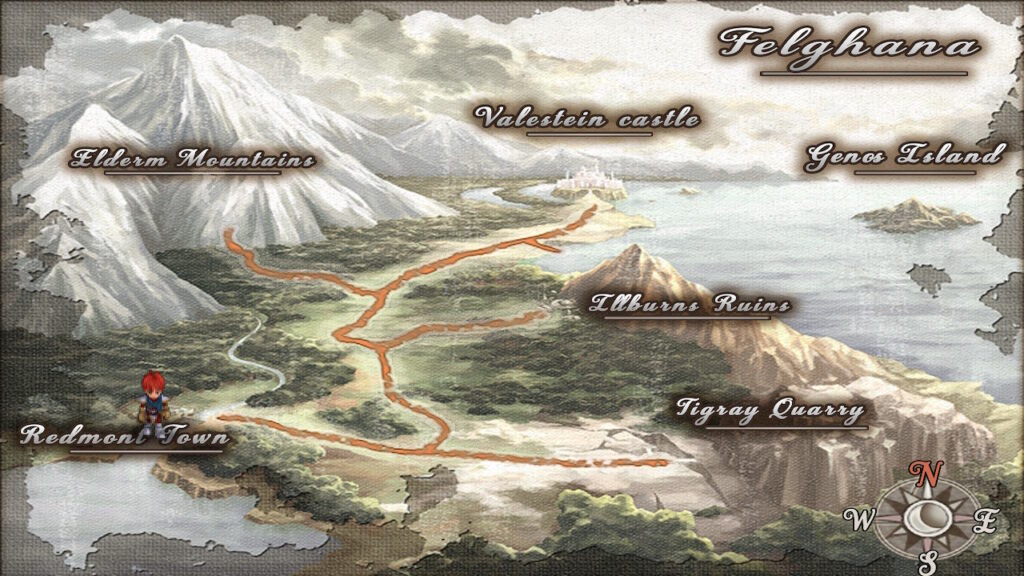
    Screenshot from Oath in Felghana showing the map.

    While Ys X: Nordics compromised this tenet somewhat to give more depth to the ship combat and exploration, in essentially every other Ys game the player can freely navigate from one end of the map to the other and is sometimes even required to for story purposes.  

    This also ties in with the general Metroidvania trend of back-tracking. While few Ys games necessitate back-tracking, almost all of them encourage it. You backtrack with new abilities to get more treasure or unlock secrets. Doesn’t that sound familiar?

    1. Trash Mobs and Tough Bosses

    Finally, and in my opinion behind only ability gating in importance, each Ys game has a structured model of running through respawning trash mobs in order to reach a boss fight which often relies on recently learned mechanics or abilities.

    While the final part of that – the addition of mechanics – is not universally true across Ys games, it is an extremely common feature.

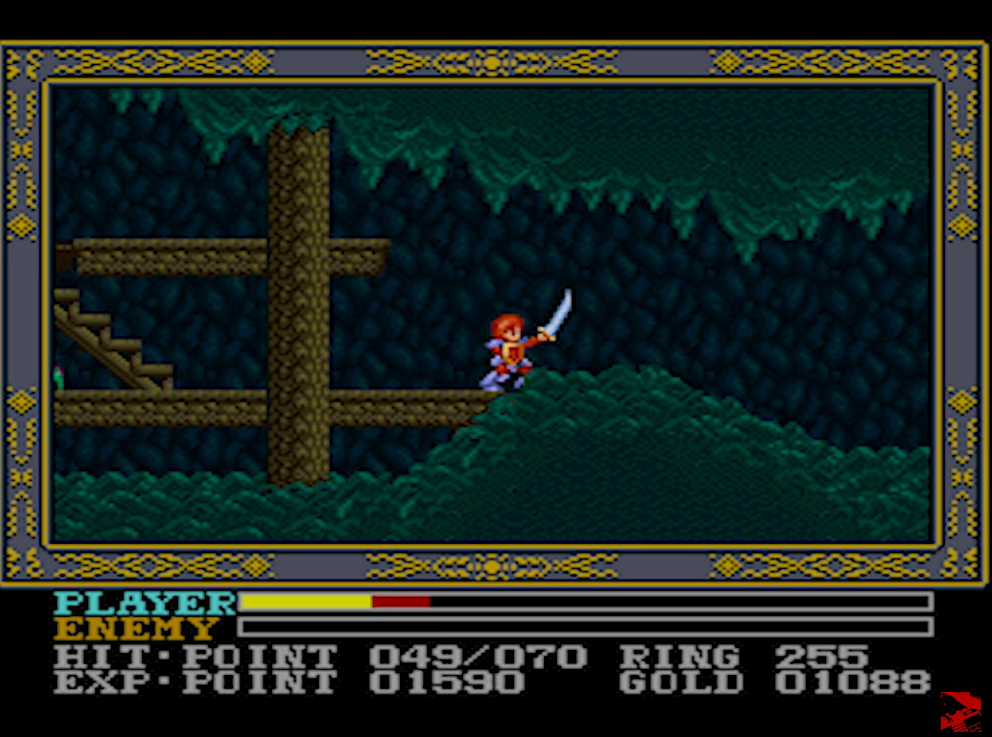
    Screenshot of Ys III: Wanderers from Ys
    Taken from NintendoComplete: https://www.youtube.com/watch?v=I8Tcdm2foE0

    All you have to do is look at Ys III: Wanderers from Ys to see how this mechanics looks in 2D. This screenshot on its own gives me intense Castlevania vibes, and even in the 2.5D or 3D games, that feeling of combat progression persists.


    So, there you have it. Indisputably, Ys is a Metroidvania as much as it is an Action RPG.

    (Author’s note: I just started playing a translated version of Ys V. I can say firmly that Ys V is not a Metroidvania. The other points still stand!)

    Disagree? Agree? Let me know in the comments!